We specialize in polarization-resolved fluorescence imaging. What can we do for you?
Polarization-resolved fluorescence imaging is suitable for observing membrane proteins and cytoskeletal proteins labeled with a fluorescent moiety (such as a fluorescent protein). The technique detects the angle at which the fluorescent moiety is oriented with respect to the cell membrane (or cytoskeleton). If the mean tilt angle (or the distribution of the tilt angle) changes during a molecular process, you can observe this process by polarization-resolved fluorescence microscopy.
For example, the technique has been shown to be exceptionally sensitive in direct detection of G-protein activation. In a resting state, the G-protein subunits form a trimer, restricting the orientational freedom of the fluorescent label. During activation, the orientational freedom of the label increases. After activation ends, the orientational freedom decreases again, due to formation of the G-protein dimer. The process is illustrated below.
Fluorescent protein orientation changes during G-protein activation:
For example, the technique has been shown to be exceptionally sensitive in direct detection of G-protein activation. In a resting state, the G-protein subunits form a trimer, restricting the orientational freedom of the fluorescent label. During activation, the orientational freedom of the label increases. After activation ends, the orientational freedom decreases again, due to formation of the G-protein dimer. The process is illustrated below.
Fluorescent protein orientation changes during G-protein activation:

This is what it looks like in two-photon polarization microscopy images:

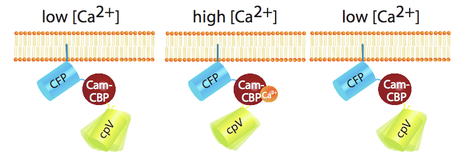
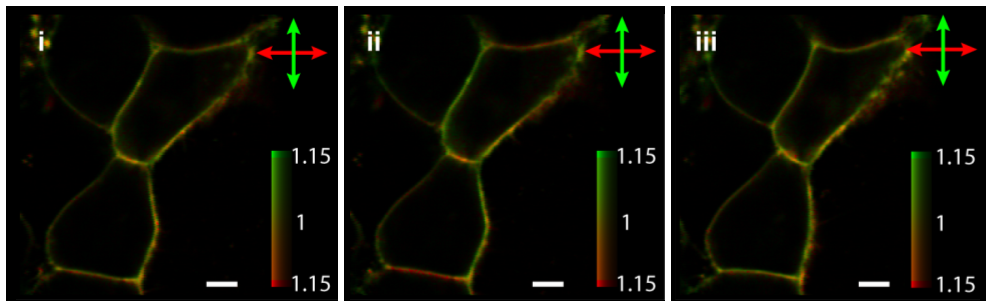
Two-photon polarization microscopy can even detect changes in membrane protein conformation, such as in a genetically encoded calcium sensor:
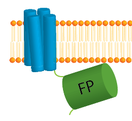
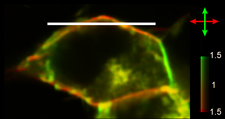
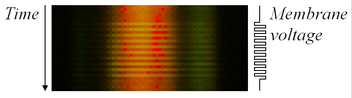
Polarization-resolved fluorescence microscopy can detect voltage-induced changes in the orientation of a fluorescent protein in a genetically encoded membrane voltage sensor, making a non-ratiometric sensor into a ratiometric one:
|
|
|
Polarization-resolved fluorescence microscopy is particularly powerful in combination with FL!P™ biosensors, developed specifically for the technique. Innovative Bioimaging provides cutting edge hardware and software tools to take advantage polarization-resolved fluorescence microscopy. It also provides polarization-resolved fluorescence microscopy as a service. Learn more from our pages, or contact us for more information!